Thursday, 14 June 2012

Diane's Funerary Chapel at Anet


On this date in 1793, two commissioners of the Sûreté from Dreux, with a handful of protesters, desecrated Diane's resting place, opened her coffin and hurried her body in a hastily dug grave in the parish churchyard.    

Alexandre Lenoir, art lover and founder of the Musée des Monuments Français in Paris, succeeded in rescuing numerous treasures torn from the château. He persuaded the State to buy many of the scattered pieces of Diane's tomb: the funerary statue, the black marble sarcophagus - which was being used as a pig trough at a neighboring farm - and the altar piece by Pierre Bontemps.

Visitors to Anet can visit the funerary chapel and see it exactly as it was in the years following Diane’s death. The centrepiece of the chapel is the sarcophagus upon which a kneeling figure of Diane de Poitiers  is mounted on a cenotaph of black marble.

Enjoy these photographs!


Monday, 19 March 2012

HD at Anet

A lasting tribute!
I have recently been asked to include posts about Diane's personal style, a subject I hold very dearly! Nowhere is her essence more evident than in her homes. Unfortunately, Chenonceau had been drastically altered after Catherine de Medici claimed it for herself and tried to deface the many HD emblems Diane and Henri had placed there. Although Diane's influence is certainly to be found at Chenonceau to this day, Anet is a more accurate example.
The double D's and crescent moons in black and white, on a stone floor at Anet


The HD emblem on a beautifully cared doorway
When Diane and Henri set about re-creating Anet from the ancestral estate of Louis de Breze, they carved their monogrammed emblem throughout. It has endured through subsequent renovations, and today it is found in abundance, as the current owners strive to keep Diane's memory alive.
An elaborate dining room ceiling at Anet, with the HD emblem,
fleur de lis, crescent moons, and Diana's coat of arms

Friday, 9 March 2012

April 25, 2012 will mark the 446th Anniversary of Diane's Death...

Until that date, I am offering $10 off the cover price of A Portrait in Black and White.
This offer applies to both hardcover and softcover versions, and is limited to copies order through my website. Online retailers and bookstores will continue to offer the book at regular price.


For more information, or to order, visit http://www.dianedepoitiers.sharibeck.com/offer.html

Thursday, 1 March 2012

Robert IV de la Marck

On March 1, 1539, Françoise de Brézé, Diane’s eldest daughter, married Robert IV de la Marck in the Louvre Chapel in Paris.
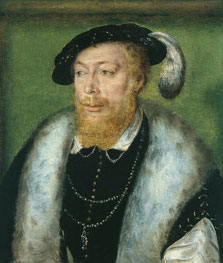
An undated portrait of Robert IV de la Marck

Robert IV de La Marck ( 1512-1556 ), was the Duc de Bouillon, Comte de Braine, and a Prince of Sedan. He was the son of Robert III de La Marck and Guillemette de Saarbrücken. Robert and Françoise had nine children.


Robert was a captain of the Hundred Swiss of the King's Guard. When Henri became King in 1547, he raised him to the office of marshal of France.
A portrait by Corneille de Lyon, c1550


In 1553 Robert was taken hostage at Therouanne, where he was very badly treated by the Spanish. His ransom was fixed at such a high sum that was eventually released on his honor to raise the money. Françoise was forced to sell much of her inheritance from her father. He was released from prison, but tragically he died on his way back home.  He was buried at St. Lawrence, Sedan.
Chateau de Sedan, as it appears today

Sunday, 26 February 2012

Queen Eleonore of France


Eleonore, the second wife of Françoise I, died on February 25, 1558.

Eleonore of Austria (1498-1558) was the daughter of Philip, Archduke of Austria and Duke of Burgundy and of Joanna of Castile. She was the sister of Holy Roman Emperor Charles V, Holy Roman Emperor Ferdinand I, Queen Isabella of Denmark, Queen Mary of Hungary and Queen Catherine of Portugal. She was born in Louvain, Belgium.
Eleanor of Austria

 When she was young, her parents attempted to arrange a marriage with the King of England, Henry VIII. Instead, he married Eleonore’s aunt, Catherine of Aragon. They also tried to marry her to Louis XII and Sigismund I of Poland.

In 1517, Eleonore fell in love with Frederick of the Palatinate. Charles was enraged and expelled Frederick from court. Eleonore followed her brother to Spain later that year. Charles arranged a marriage between Eleonore and King Manuel of Portugal, who had previously been married to two of her aunts, to avoid the possibility of Portuguese assistance to any rebellion in Castile.

Eleonore married François I of France on July 8, 1530. Before her marriage to François I became part of the conditions of the Treaty of Cambrai, she had planned to marry his nemesis, Charles de Bourbon.

The King of France was more interested in his mistress, Anne de Pisseleu, than his new wife. On her arrival in France Eleonore made the acquaintance of Diane de Poitiers, who became her maid of honour. There was a little over a year’s difference in their ages. Eleonore’s coronation was held March 5, 1531. It was at the tournament to celebrate the coronation that Henri first asked to carry Diane’s colours.

Eleonore’s marriage to François was purely political. She spent her entire marriage attempting to establish peaceful relationship between her husband and her brother.

Diane remained grateful to Eleonore for her kindness toward Henri and his brother, when they were held hostage in Spain as children. When the King died in 1547, Eleonore was not present, nor was she informed of her husband’s death. Diane was not pleased, and she told Henri so.

Friday, 17 February 2012

The Day Jean de Poitiers was Spared

Diane’s father, Jean de Poitiers, had been sentenced to death by beheading for his role in Charles de Bourbon’s treason against the King. Thanks to Diane’s intervention, his life was spared.
February 17, 1524 was the day that had been set for the execution. Despite the King’s promise to Diane, her father was stripped of his Order of Saint Michel and all of his titles and honors. He made his will and prayed with his priest. At three o’clock in the afternoon, his hands were tied and he was placed on a horse for the short ride along Rue Grenier-sur-l’Eau to the Place de Grève. 


He was shaking from fever and he was so weak he needed to be supported by a man on either side. He was led to his place of execution, stripped of his over-clothes, and left shivering, with his head on the block, for over an hour. Finally, the King’s messenger, galloped into the square, delivered the reprieve and read it aloud. The full transcript of the reprieve can be found in “A Portrait in Black and White.”
Place de Greve from an old drawing
The reprieve was granted for Jean de Poitiers’ past service to his country and his sentence was commuted to life imprisonment.
The other parties to Charles’ plot were not so fortunate. They remained in prison, and could be executed whenever the King fancied. Charles de Bourbon remained at large.
The square as it appears today,  dominated by Hôtel de Ville

Tuesday, 14 February 2012

The Marriage of Diane de France and Orazio Farnese

Diane de France, the daughter of Diane de Poitiers and Henri II of France,  turned 15 on Valentine’s Day, February 14, 1553. A day earlier, she married Orazio Farnese, Duke di Castro.

The wedding of Orazio Farnese and Diane de France

He had been born in Valentano, Italy in 1532, the second son of  Pier Luigi Farnese, Duke of Parma  and Gerolama Orsini. 

Orazio's birthplace


Orazio’s father was the illegitimate son of Cardinal Alessandro Farnese (who later became Pope Paul III). He was often referred to as the Pope’s nephew rather than his grandson.  Orazio’s father was murdered in September of 1547. 

Henri signed the marriage contract  in 1547, shortly after his coronation, when Petite Diane was only nine years old. In anticipation of the marriage, the Pope made Orazio the Duke of Castro.  He was so pleased that he sent Catherine the Golden Rose, and Diane de Poitiers a pearl necklace from the Orient.
Orazio Farnese
Diane de France


Diane and Orazio’s happiness was to be short-lived. He was killed at the Battle of Hesdin on18 July 1553. There were no children from the marriage.

He is buried in the Church of Santa Maria Assunta, Venice.
Funeral monument to Orazio Farnese